
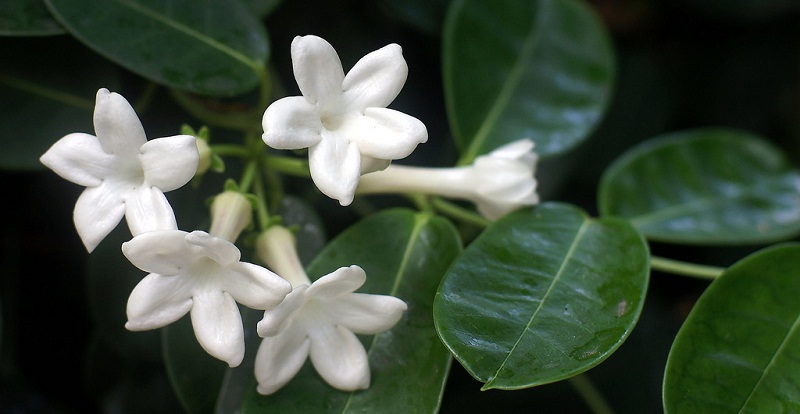
White flowers with a delicate aroma, which are very often used for bride’s bouquets – of course, we are talking about stephanotis.
Stephanotis (Stephanotis) – evergreen climbing plants with graceful white flowers that fill the room with their pleasant and delicate aroma, belongs to the freckle family. The leaves of stephanotis are oval, growing on liana-like shoots that curl along a strong support. The flowers are white, small, with a delicate smell, collected in a large inflorescence. Stephanotis blooms in adulthood (from 3 years ) from late June to September. In its natural environment, stephanotis can be found in Madagascar.
Types of stephanotis
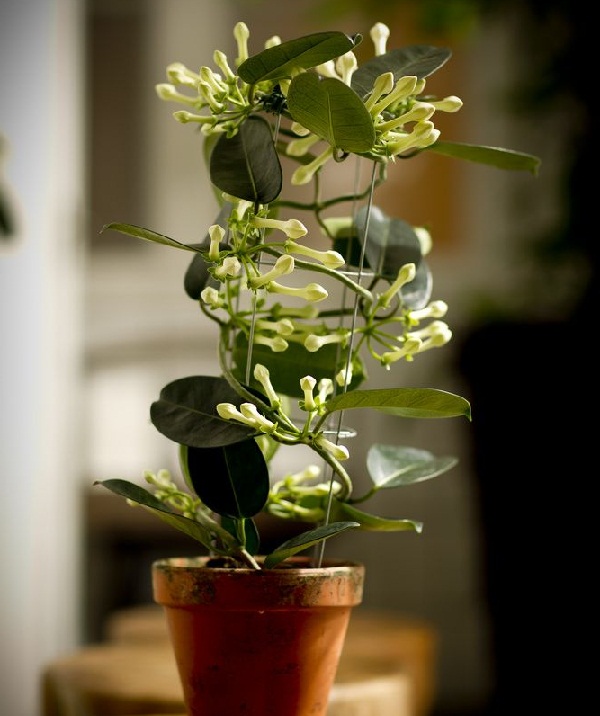
In nature, the genus Stephanotis has more than 15 species, but only Stephanotis floribunda (multi-flowered) is adapted to room conditions. Climbing shoots reach up to 5 m in length. The leaves are oval or elongated, up to 9 cm long, up to 5 cm wide, rounded at the base, dark green, glossy. The flowers are white aromants, collected in inflorescences.
How to care for stephanotis
Caring for stephanotis is not difficult if the room climate suits it. Subject to the temperature regime and sufficient illumination, stephanotis can bloom even in winter. The plant loves a lot of light and needs support.
Light brightness for stephanotis
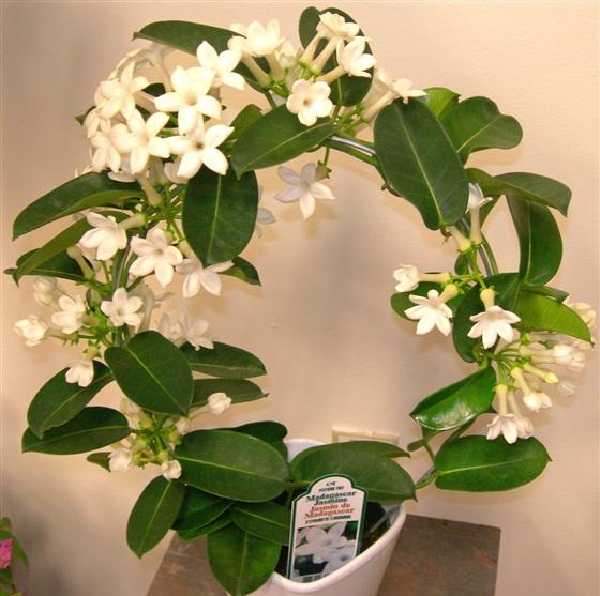
Stephanotis is a light-loving plant that requires bright lighting. In summer, it needs to be shaded from direct sunlight. The best place to grow stephanotis will be the northwest window. In winter, lighting is very important for flowering next year, place the plant on the south window, or illuminate it with fluorescent lamps. During budding, the plant cannot be rearranged, rotated.
Air temperature for stephanotis
The air temperature in the room should be +20-+25 ° C, and in winter – not lower than +12 – + 16 ° C. Protect the plant from drafts and sudden changes in temperature, which are detrimental to stephanotis.
Watering and humidity for stephanotis
From spring to autumn, water the stephanotis abundantly, but the water in the pan should not stagnate. Before the next watering, the top layer of the earthen coma should dry out. In winter, it is necessary to water stephanotis in cold rooms very rarely, when the soil is more than half dry. Use settled water for irrigation.
The air humidity for stephanotis should be high enough – 80%, spray the plant twice a day with warm water. Spraying is especially important during the heating season. If the plant hibernates in cold rooms, it is better not to spray it so that diseases do not appear. During flowering, the plant is not sprayed, but the humidity around the plant is increased.
Fertilizer for stephanotis
From spring to autumn, stephanotis should be fed 1 time in 14 days with a complex mineral fertilizer for flowering plants.
Watch the video about indoor violet. Violet flowers are multi-colored, simple, double, wavy with a diameter of 2 to 4 cm.
Transplanting and soil for stephanotis
Young stephanotis should be transplanted every year in the spring. Adult plants need to be transplanted 1 time in 2-3 years. If the soil dries out quickly after abundant watering, this is a sign for a transplant. It is better to transplant stephanotis into a pot that is not very wide, a maximum of 4 cm wider than the previous one. The soil mixture for stephanotis should consist of sod land, peat, humus and coarse sand (2: 1: 1: 1), or you can buy a ready-made soil mixture for flowering plants with an acidity of pH 5-6. Do not forget to install and securely fasten the support during transplantation.
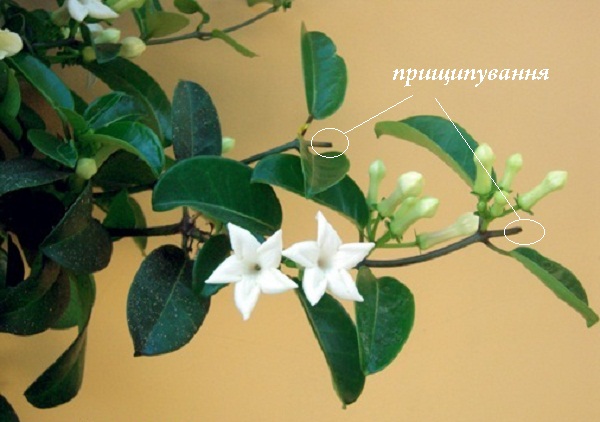
Pruning and pinching stephanotis
Flowers on the plant appear only on new shoots, so you need to prune stephanotis in winter, and pinch the shoulder straps in summer for long flowering.
Reproduction of stephanotis
Stephanotis propagates by stem cuttings in summer, layering, seeds. It is very difficult to root stephanotis cuttings at home.
Pests and diseases
Pests that can attack stephanotis: spider mites and aphids. With improper care, stephanotis can get powdery mildew.
- Труднощі у догляді:
- The leaves turn yellow – lack of light, the water for irrigation is hard with lime.
- Does not bloom – sudden changes in temperature, not enough light.
- The buds fall off – not enough light, overdraft, insufficient watering.


