
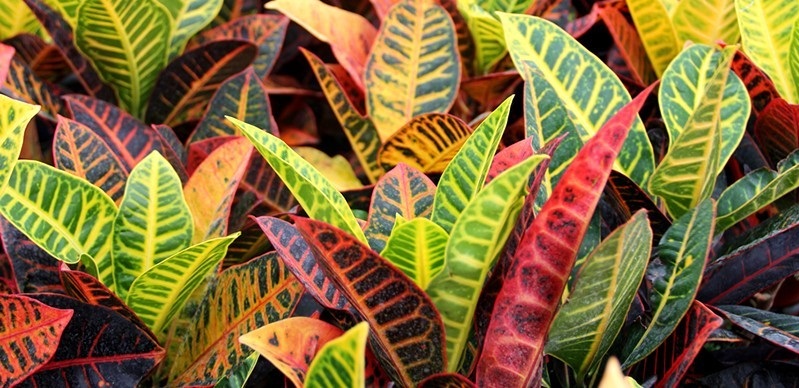
Croton or codiaeum (Codiaeum) is one of the popular indoor plants, and this is not surprising, the leaves of this plant are simply striking in their color and shape. Croton is an ornamental evergreen shrub with large, shiny, brightly colored leaves from the Euphorbiaceae family. The color of the leaf of the croton is dark green, on which the following are randomly scattered: pink, yellow, gray, light green dots and stripes, and the veins of the leaf are bright red or yellow. It is for the beautiful natural painting on the leaves that croton is valued. Croton blooms. The flowers are inexpressive, collected in inflorescences, hanging down to the bottom and do not present any decorative effect.
In its natural environment, croton can be found in the South-East. Asia, Australia, Malaysia, as well as on the islands of the Pacific Ocean. In nature, there are about 15 species of croton, variegated croton and its hybrids are adapted to room conditions. The genus of crotons includes herbaceous, bushy plants and trees. In the natural environment, the height of the croton reaches up to 4 meters, and in room conditions it will be much lower – up to 1.5 meters. Croton hybrids differ in the shape of the leaves, they can be pawed, oak-shaped, oval-elongated, which are located on the trunk of the plant, the edge of the leaf blade is even or wavy.
Attention! Croton has a milky sap, which is very poisonous, so after working with it, it is necessary to rinse your hands thoroughly and put the plant out of the reach of children and pets.
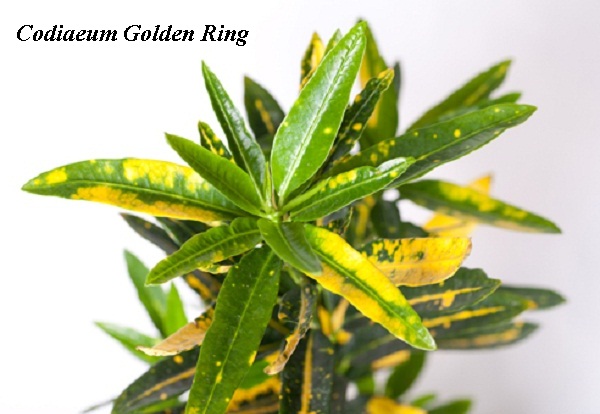
How to care for a croton
Croton is a rather capricious houseplant, it is afraid of direct sunlight, and also does not tolerate a change of place and a sharp temperature fluctuation. Crotons decorate winter gardens, they look beautiful in the interior of an apartment and office.
Brightness of light for croton
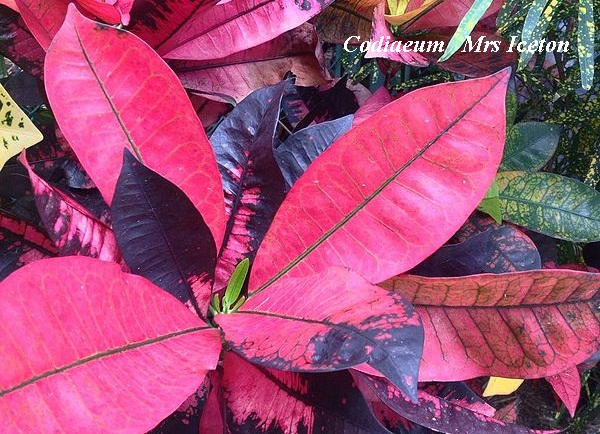
Croton is a light-loving plant, a place with bright lighting, but not direct sunlight, is suitable for it. The best place for growing croton is the West. and East. windows of houses or apartments, South. The sides of the houses may also be suitable if the plant is placed away from the window. If the plant lacks light, it will immediately let you know – the leaves will lose their color pattern and become monochromatic.
Air temperature for croton
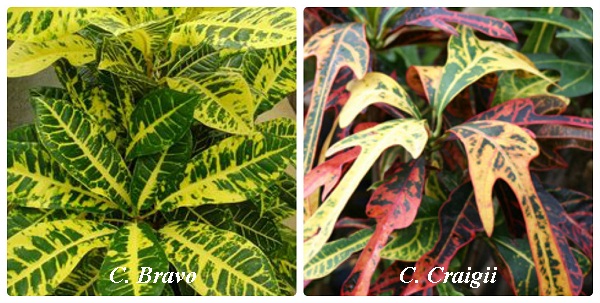
Croton is a heat-loving plant. Indoors, it is better to grow it in warm rooms, where the air temperature will not change sharply, that is, it should be uniform in the range of +18-+22°C at different times of the year, but not lower than +17°C.
Watering and air humidity for croton
You need to water the croton regularly, the earthen clod should not dry out, the soil should always be moist, but not wet(the roots may rot). Use water for irrigation at soft room temperature.
Молодий (до 4 р) кротон пересаджують раз на 2 роки, дорослий рідше – у міру зростання кореневої системи. Для пересадки кротона використовуйте універсальну грунтосуміш. Грунтосуміш для кротону можна приготувати і власноруч: листова, дернова земля, з додаванням піску, перегною і торфу (2:2:1:1:1). Як пересаджувати рослини?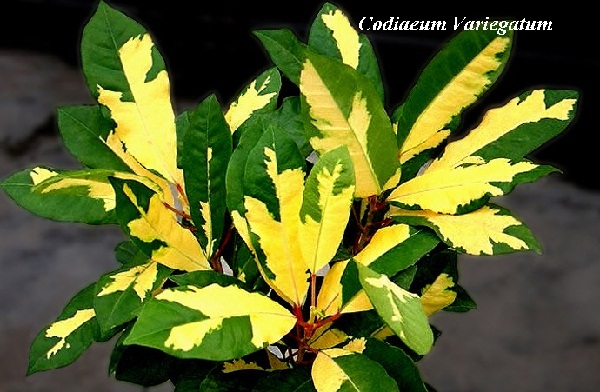
Reproduction of croton
Croton propagates in the same way as poinsettia – by cuttings and seeds.
For successful rooting of croton cuttings, you need to use phytohormones (rooting) and bottom heating.
Pests and diseases
Croton can be threatened by spider mites, scale insects.
Diseases appear with improper care:
Croton leaves fall off – the reason is overdrying of the earthen coma, draft, a sharp change in temperature.
The leaves lose their color – the reason is insufficient light.
Вологість повітря для кротона повинна бути досить високою більше 65 %. У літній і опалювальний період рослину треба обприскувати 2 рази на день, або щодня протирати листки вологою ганчіркою, також кротон добре реагує га миття листя під теплим душем, так, щоб вода не потрапляла в горщик(1 раз на 30 днів робіть йому теплий душ). Як збільшити вологість повітря? 
Croton fertilizer
Croton needs to be fed with complex mineral fertilizers for decorative deciduous plants: in summer once every two weeks, in winter – once a month.
Watch the video about indoor violet. Violet flowers are multi-colored, simple, double, wavy with a diameter of 2 to 4 cm.
Croton transplant
Молодий (до 4 р) кротон пересаджують раз на 2 роки, дорослий рідше – у міру зростання кореневої системи. Для пересадки кротона використовуйте універсальну грунтосуміш. Грунтосуміш для кротону можна приготувати і власноруч: листова, дернова земля, з додаванням піску, перегною і торфу (2:2:1:1:1). Як пересаджувати рослини?
Розмноження кротону
Croton propagates in the same way as poinsettia – by cuttings and seeds.
For successful rooting of croton cuttings, you need to use phytohormones (rooting) and bottom heating.
Шкідники та хвороби
Croton can be threatened by spider mites, scale insects.
Diseases appear with improper care:
Croton leaves fall off – the reason is overdrying of the earthen coma, draft, a sharp change in temperature.
The leaves lose their color – the reason is insufficient light.


