
If there is a desire to equip borders-banks around flower beds, or decorate the boundaries of paths on a personal plot with them, you do not always need to buy ready-made fences. In this place, you should show a little imagination and work a little. For example, you can weave them from a rod – it will turn out originally, not like everyone else’s, while you can buy something useful with the money saved.
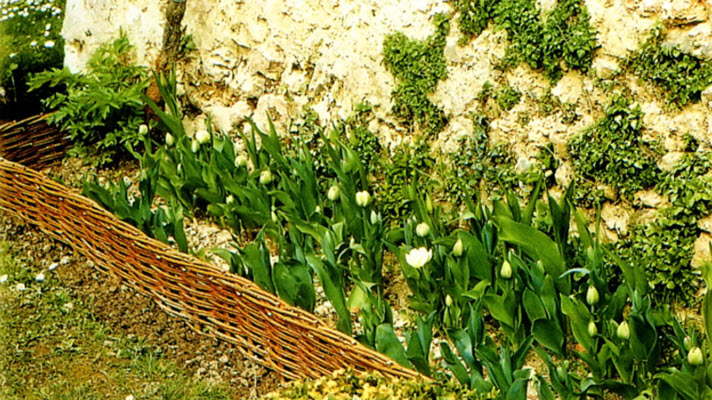
If there is a desire to equip borders-banks around flower beds, or decorate the boundaries of paths on a personal plot with them, you do not always need to buy ready-made fences. In this place, you should show a little imagination and work a little. For example, you can weave them from a rod – it will turn out originally, not like everyone else’s, while you can buy something useful with the money saved.
Vine is an ideal natural material for creating a small fence in a vegetable garden or garden that will be in harmony with the nature that surrounds it. Willow, hazel and other trees and shrubs with long, flexible branches can be used as vines.
Low, wicker fences made of flexible rods along the beds are not only decorative decoration, they do not allow the earth to crumble and naturally separate cultivated plants from the aisles and paths.
You can harvest the vine at any time, but it is better to do it from January to March. The main thing is that the rod is flexible and thin, 150 – 180 centimeters long. Store it in handfuls, preferably in a cold room, such as a barn. Before weaving, the rods should be soaked and sorted by thickness and length.
The basis of the wattle fence is pegs driven into the ground at a distance of 10 – 15 centimeters from each other. Pegs are cut from thicker branches. You can weave a fence into several rods at once, getting a pattern in the form of flat ribbons. After 5 – 6 rows, for greater strength, thicker branches should be inserted next to the first pegs, which complete the weaving. The protruding ends of the rods are cut with pruning shears.
Along the line of the future wattle, pegs or rough pieces of rods are vertically stuck into the ground at regular intervals.
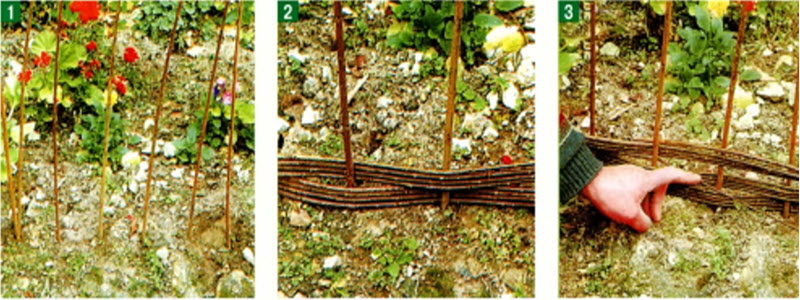
1. The first “ribbon” of four rods is used to braid pegs at ground level, the second – with a shift of one peg.
2. Each row is woven to the end to get a strong “ribbon”. The thin tips of the rods are cut with pruning shears and continue weaving with other rods.
3. The height of the braided pegs should be a few millimeters higher than the height of the wattle.
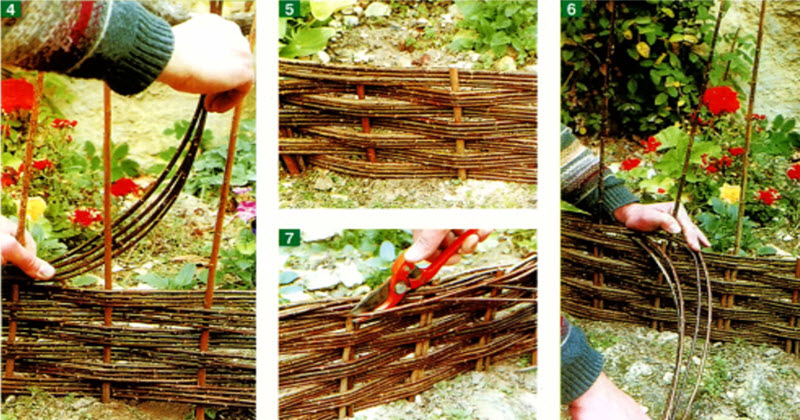
4. The protruding ends of the rods are cut with pruning shears and hidden in a “tape” near the peg.
5. When the weaving reaches the seventh row, rods are stuck next to the peg, which should be used to fix the weaving.
6. Inserted high rods are alternately bent and braided into the upper “ribbon”. The thin ends are trimmed with pruning shears.
The vine used for weaving should be straight and flexible, have little variability, healthy and dense wood, even without defects, smooth surface of the bark of uniform color.


