
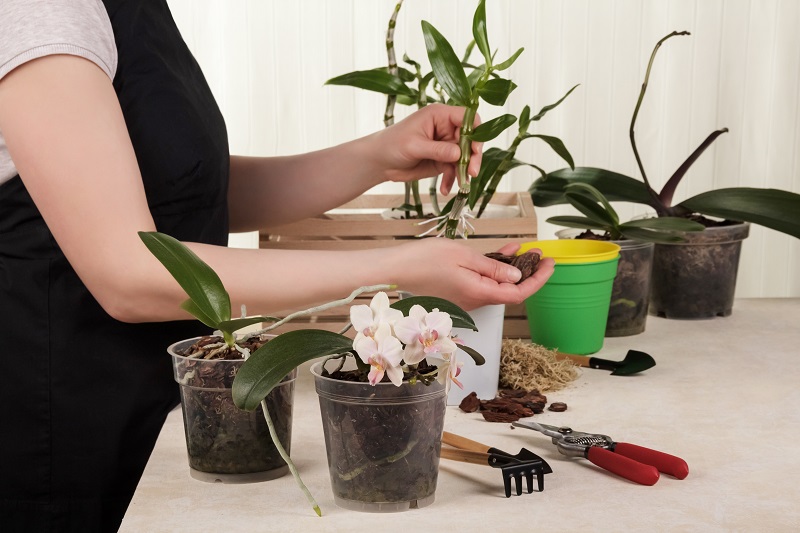
When to transplant a dendrobium orchid?
Dendrobium orchids need to be transplanted every two years.
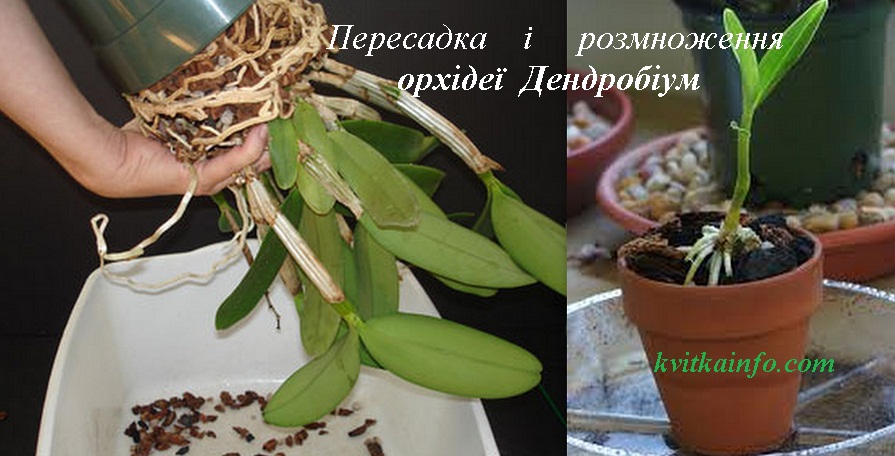
The dendrobium orchid should be transplanted after flowering, and species that bloom in autumn should be transplanted with the beginning of the growth of young shoots, and those that bloom in winter-spring should be transplanted after flowering.
See also: How to care for the Dendrobium orchid?
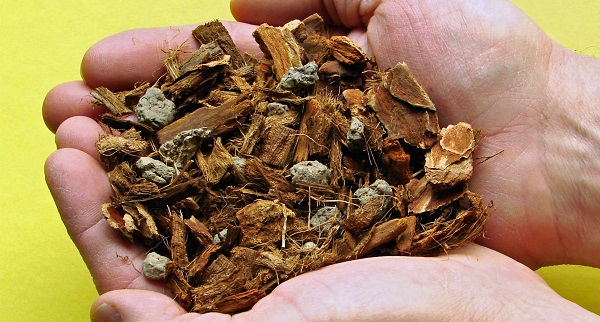
What soil is needed for a dendrobium orchid
Dendrobiums form a large number of “babies”. Babies are small plants with leaves and roots at the nodes of the stem of the mother orchid. Dendrobium babies are suitable for reproduction, the length of the roots of which has reached up to 6 cm. Young dendrobiums are planted in small pots in early summer.
- You need to take a sharp knife, disinfect it and cut off the baby, leaving 1 cm of the stem.
- Soak the roots of a freshly cut plant for 5 minutes.
- Plant a young plant in a pot with a substrate. It is easy to compact the substrate around the roots.
- When planting dendrobium babies, the growth point should remain on the surface of the soil.
- The substrate with young dendrobiums is kept moist (without stagnant water!) until young leaves begin to appear. Next, you should take care of it like an ordinary dendrobium orchid.
How to separate a baby dendrobium from the mother plant?
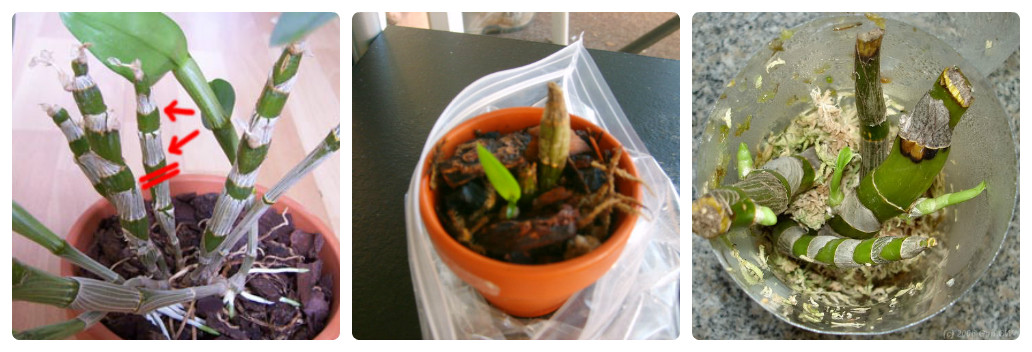
Propagation of Dendrobium by stems
Dendrobium can also be propagatedstems by cutting off the faded stems of the plant at soil level and cutting them into parts with two small nodes, placing them horizontally on a moist shallow substrate or on moist moss – sphagnum. The humidity of the substrate and moss is maintained for several months at a temperature of 25° C (wrap the planted stems together with the pot in cirata, ventilate from time to time). Babies can form on the stems of dendrobium, which can be transplanted into separate pots at the end of summer, when young shoots reach 5 cm and take root.
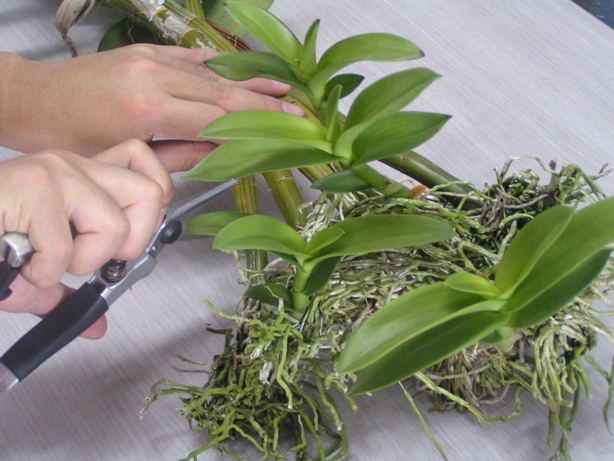
Dividing the bush when transplanting
When transplanting, the plant can be divided so that each plant has at least 3 pseudobulbs. We remove rotten roots and very old pseudobulbs.
Reasons for dendrobium transplant:
- the roots have outgrown the pot (once every 2 years);
- If the bark crumbles;
- too much seaweed in the pot;
- pests appeared;
- the dendrobium bush is too dense;
- there is a lot of salt in the substrate (the bark is covered with a white coating).
. . . . . .
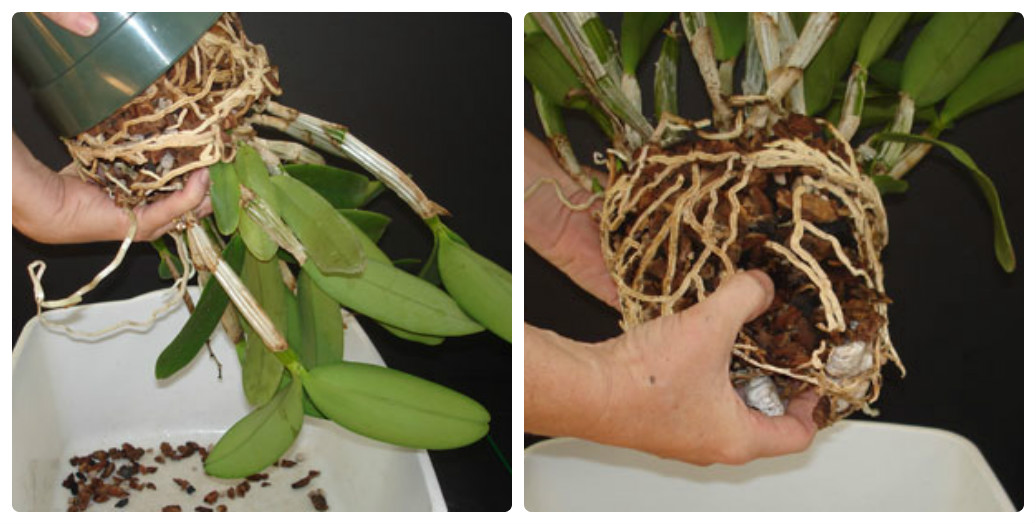
- Place the dendrobium pot in a tray and gently fill with water for 10 minutes. The roots will become elastic and the orchid will stretch easily.
- Gently take the orchid by the trunk under the leaves and remove it from the pot.
- It is necessary to remove the old soil and cut off the rot, disinfect all sections. We do it in the same way as in transplanting a phalaenopsis orchid.
- We plant the orchid in prepared pots.
- The new substrate must be sterilized before use.
- Place a layer of soil (3cm) at the bottom of the pot, place the plant in the center so that it is not too deep, fill the empty space with substrate and gently press it so that the plant is fixed.
- A newly transplanted orchid needs to be provided with high humidity and moderate brightness.
- After transplanting, the plant does not need to be watered for 5 days.
Step by step to transplant a dendrobium
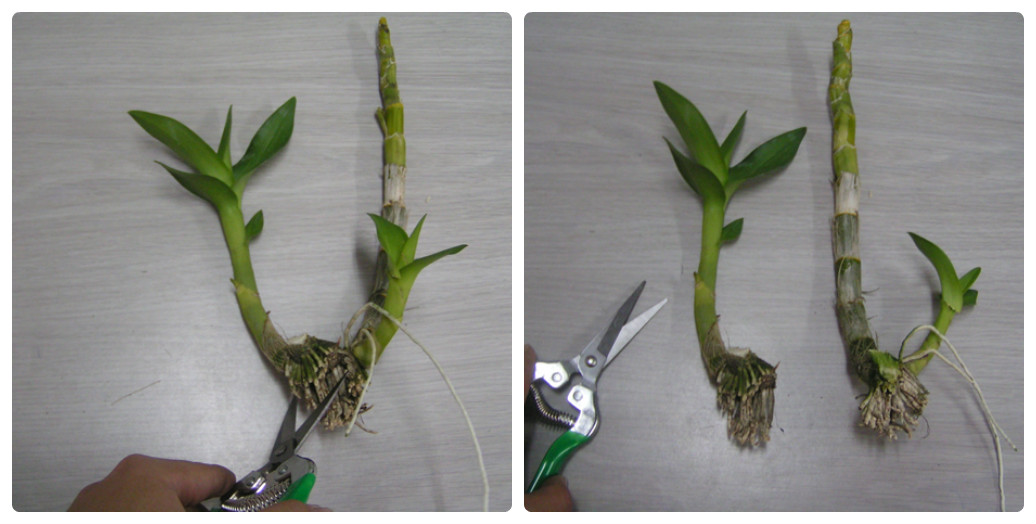
Reproduction of the dendrobium orchid
At home, dendrobium can only be propagated vegetatively: by children, stems or by dividing the bush during transplantation.
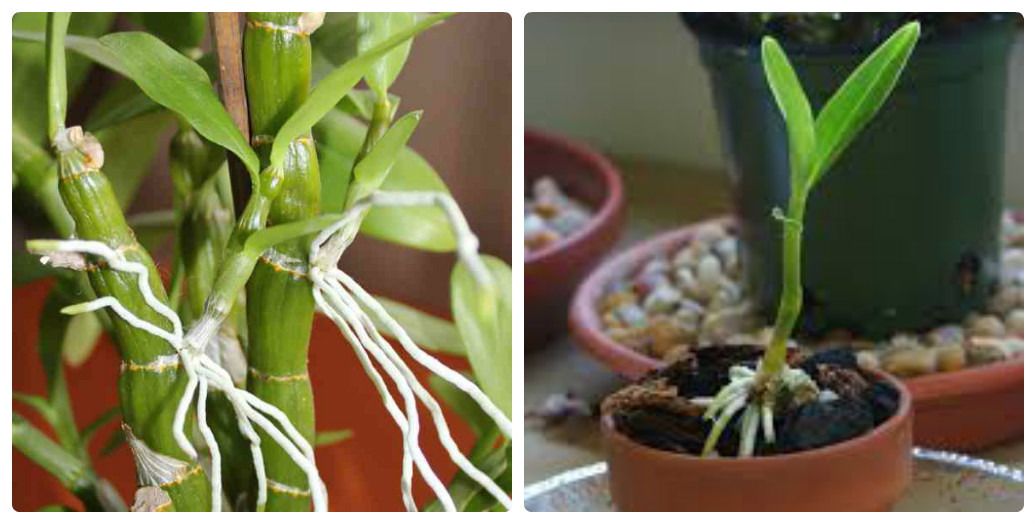
Reproduction by children
Dendrobiums form a large number of “babies”. Babies are small plants with leaves and roots at the nodes of the stem of the mother orchid. Dendrobium babies are suitable for reproduction, the length of the roots of which has reached up to 6 cm. Young dendrobiums are planted in small pots in early summer.
How to separate a baby dendrobium from the mother plant?
- You need to take a sharp knife, disinfect it and cut off the baby, leaving 1 cm of the stem.
- Soak the roots of a freshly cut plant for 5 minutes.
- Plant a young plant in a pot with a substrate. It is easy to compact the substrate around the roots.
- When planting dendrobium babies, the growth point should remain on the surface of the soil.
- The substrate with young dendrobiums is kept moist (without stagnant water!) until young leaves begin to appear. Next, you should take care of it like an ordinary dendrobium orchid.
Propagation of Dendrobium by stems
Dendrobium can also be propagatedstems by cutting off the faded stems of the plant at soil level and cutting them into parts with two small nodes, placing them horizontally on a moist shallow substrate or on moist moss – sphagnum. The humidity of the substrate and moss is maintained for several months at a temperature of 25° C (wrap the planted stems together with the pot in cirata, ventilate from time to time). Babies can form on the stems of dendrobium, which can be transplanted into separate pots at the end of summer, when young shoots reach 5 cm and take root.
Dividing the bush when transplanting
When transplanting, the plant can be divided so that each plant has at least 3 pseudobulbs. We remove rotten roots and very old pseudobulbs.
Dendrobium requires a substrate that consists of bark (the substrate should contain the bark of hardwoods: oak, hornbeam, etc., pine in small quantities may also be suitable) with the addition of sphagnum moss and charcoal. It is advisable to put a layer of gravel at the bottom of the pot so that the pot with the plant does not tip over, cover the bark with a layer of 2 cm, put the plant and cover the roots; Place a layer of sphagnum moss on top so that the water does not evaporate very quickly.
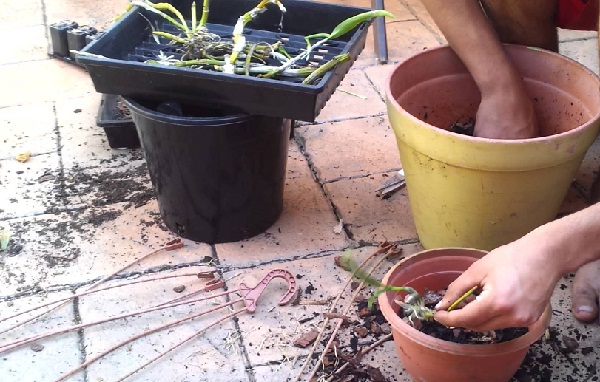
How to choose a pot for a dendrobium orchid
Dendrobium can grow in opaque pots. Dendrobium is a plant that is quite tall and it is necessary to choose stable pots for it, you can use clay, plastic (pour stones or expanded clay on the bottom for greater strength) and special baskets for orchids.
The size of the pot should correspond to the size of the root system: the root system should enter the pot freely, while there should be a maximum of 1-2 cm of free space at the edges for root growth.
Read also Orchids – orchid care
How to transplant a dendrobium orchid
When transplanting, the plant can be divided so that each plant has at least 3 pseudobulbs. We remove rotten roots and very old pseudobulbs.
Reasons for dendrobium transplant:
- the roots have outgrown the pot (once every 2 years);
- If the bark crumbles;
- too much seaweed in the pot;
- pests appeared;
- the dendrobium bush is too dense;
- there is a lot of salt in the substrate (the bark is covered with a white coating).
- Place the dendrobium pot in a tray and gently fill with water for 10 minutes. The roots will become elastic and the orchid will stretch easily.
- Gently take the orchid by the trunk under the leaves and remove it from the pot.
- It is necessary to remove the old soil and cut off the rot, disinfect all sections. We do it in the same way as in transplanting a phalaenopsis orchid.
- We plant the orchid in prepared pots.
- The new substrate must be sterilized before use.
- Place a layer of soil (3cm) at the bottom of the pot, place the plant in the center so that it is not too deep, fill the empty space with substrate and gently press it so that the plant is fixed.
- A newly transplanted orchid needs to be provided with high humidity and moderate brightness.
- After transplanting, the plant does not need to be watered for 5 days.
Step by step to transplant a dendrobium
Reproduction of the dendrobium orchid
At home, dendrobium can only be propagated vegetatively: by children, stems or by dividing the bush during transplantation.
Reproduction by children
Dendrobiums form a large number of “babies”. Babies are small plants with leaves and roots at the nodes of the stem of the mother orchid. Dendrobium babies are suitable for reproduction, the length of the roots of which has reached up to 6 cm. Young dendrobiums are planted in small pots in early summer.
- You need to take a sharp knife, disinfect it and cut off the baby, leaving 1 cm of the stem.
- Soak the roots of a freshly cut plant for 5 minutes.
- Plant a young plant in a pot with a substrate. It is easy to compact the substrate around the roots.
- When planting dendrobium babies, the growth point should remain on the surface of the soil.
- The substrate with young dendrobiums is kept moist (without stagnant water!) until young leaves begin to appear. Next, you should take care of it like an ordinary dendrobium orchid.
How to separate a baby dendrobium from the mother plant?
Propagation of Dendrobium by stems
Dendrobium can also be propagatedstems by cutting off the faded stems of the plant at soil level and cutting them into parts with two small nodes, placing them horizontally on a moist shallow substrate or on moist moss – sphagnum. The humidity of the substrate and moss is maintained for several months at a temperature of 25° C (wrap the planted stems together with the pot in cirata, ventilate from time to time). Babies can form on the stems of dendrobium, which can be transplanted into separate pots at the end of summer, when young shoots reach 5 cm and take root.
Dividing the bush when transplanting
When transplanting, the plant can be divided so that each plant has at least 3 pseudobulbs. We remove rotten roots and very old pseudobulbs.


