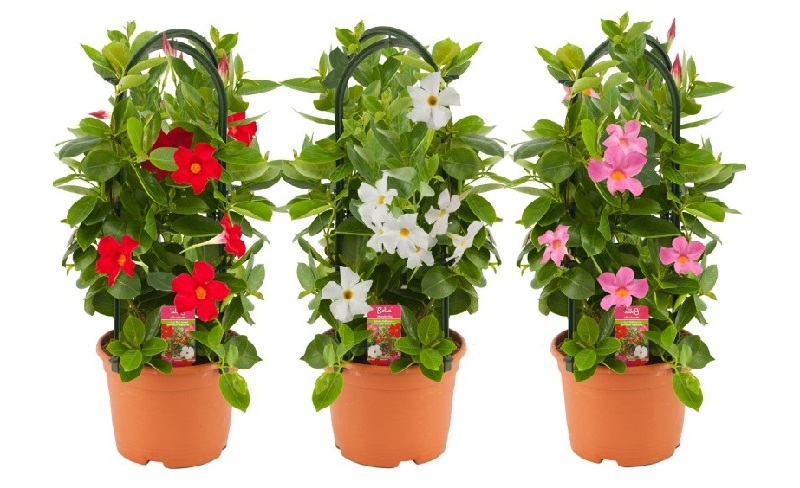
Dipladenia (Dipladenia) is an ornamentally flowering, perennial plant growing as a vine, belongs to the Kutrov family, also called Mandeville (Mandevilla) and Sundavilla Sundavilla. In fact, they are different plants, although very similar in appearance. How to care for Dipladenia?
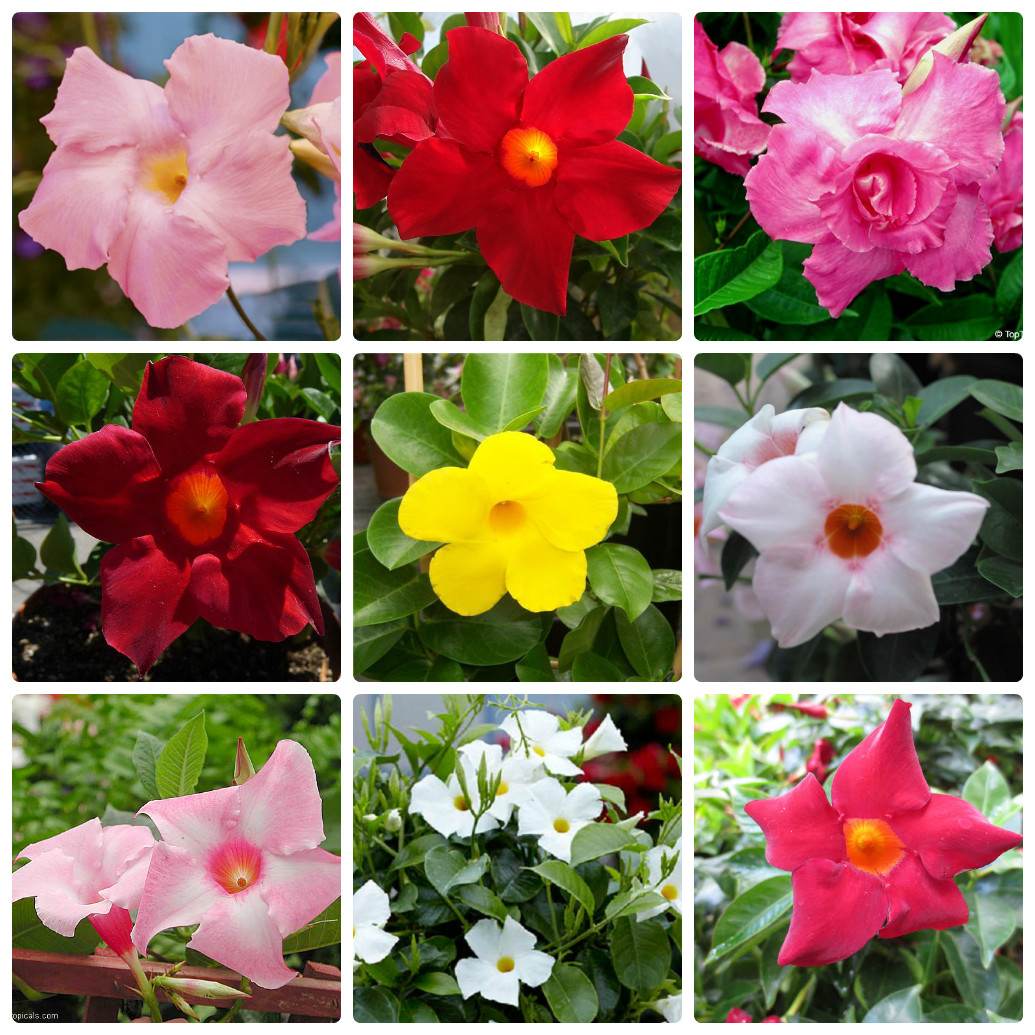
Dipladenia blooms with ornamental flowers of different colors: red, pink, white, cream, burgundy, bicolor; They have a tubular shape with individual petals up to 8 cm in diameter, one flower blooms for quite a long time – up to 14 days, some species smell. With proper care, Dipladenia blooms for 6 months: from May to the end of autumn. Flowers are located on the vine singly, on an adult vine up to 60 flowers can bloom at the same time.
Attention! Dipladenia, like many representatives of the Kutrov family, is a poisonous plant, all its parts contain dangerous cardiac glycosites. When caring for a flower, you need to be careful, especially be careful if there are children in the house.
The genus Dipladenia unites more than 100 species of plants. In nature, these heat-loving vines grow in tropical and subtropical forests of Central and South America, Brazil – on the slopes of the Organ mountain range, near Rio de Janeiro.
Dipladenia of various species adorn gardens, courtyards and houses.
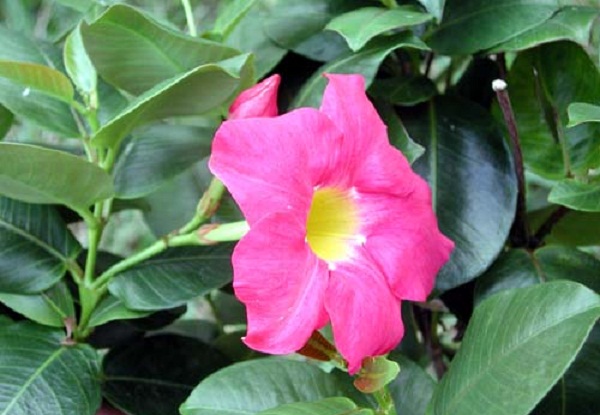
- Dipladenia sanderi is an indoor vine with green, shiny leaves, in the axils of which there are inflorescences of pink flowers with a yellow center of flowers up to 8 cm in diameter.
- Dipladenia splendens is common as an ampelous indoor evergreen. The stems of young plants are lowered, reaching 3 m, the leaves are large – up to 7 cm long, oval with a pointed end, pubescent on the underside, with a pronounced network of veins. The flowers are bright pink, up to 10 cm in diameter, or purple.
- Dipladenia eximia is an elegant plant with thin, slightly pubescent stems and small leaves (up to 4 cm long); large pink flowers with bright red flowers.
- Dipladenia laxa is a fast-growing plant with climbing stems, reaching 6-7 meters in nature. The leaves are gray-green, ovoid, glabrous above, drooping, up to 15 cm long. The flowers are white or cream, fragrant, up to 5 cm in diameter. More hardy than previous species, it can survive at 9-10 ° C. Deciduous vine in Western Europe hibernates in the open field. It does not shed leaves in the room.
- Dipladenia bolewiensis is a vine with smooth stems and shiny oval small leaves, in the axils of which there are white fragrant flowers up to 5 cm in diameter.
- Dipladenia ‘Red Riding Hood’ is cherry pink.
- Dipladenia ‘Scarlet Pimpernel’ is red, its bright flowers shimmer in the sun with all shades of red.
- Dipladenia Faire Lady (“Beautiful Lady”) and “Summer Snow” (“Summer Snow”) are snow-white varieties.
- Dipladenia “Yellow” – yellow, as if shining gold.
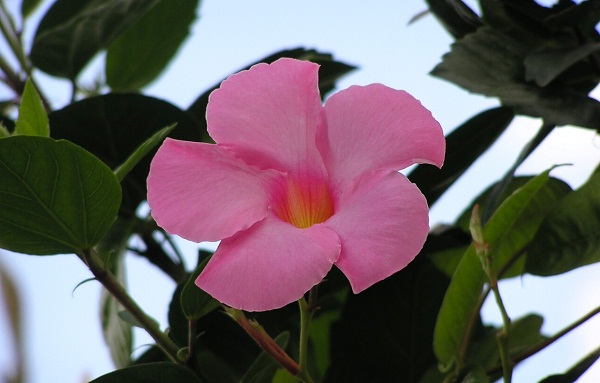
- Dipladenia ‘Alice du Pont’ is a pale pink , a well-known species that can bloom all year round.
- Dipladenia ‘Pink Parfeit’ – has wonderful multi-petaled flowers that smell very pleasant. Sometimes this beauty is also called the “Thai rose”.
- Dipladenia sun Parasol Crimson. – the flower petals of this dipladenia are not rounded, but pointed, resembling fragrant tobacco flowers in shape.
Types of Dipladenia:
See also:ORCHIDS – ORCHID CARE
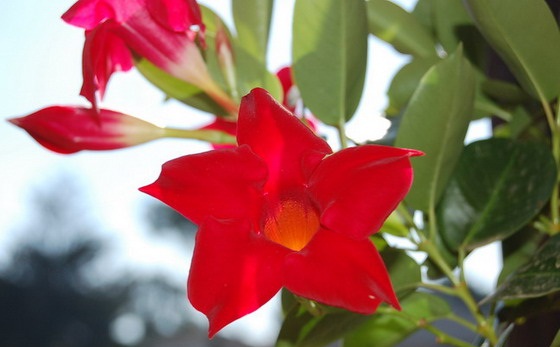
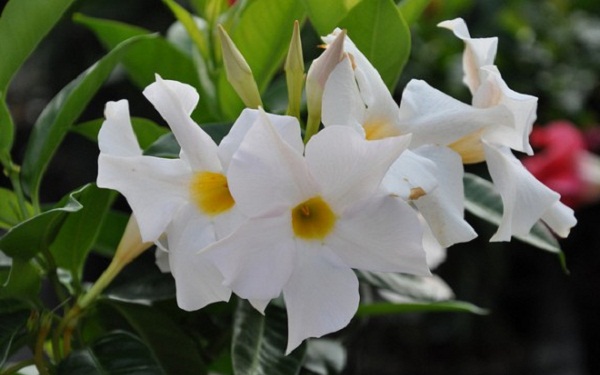
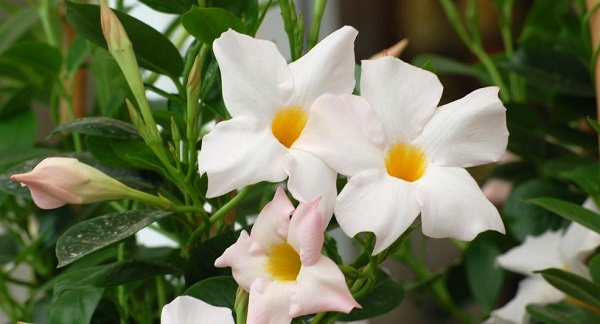
Not only natural species are grown in pots, but also numerous hybrid varieties, among which the most popular are: